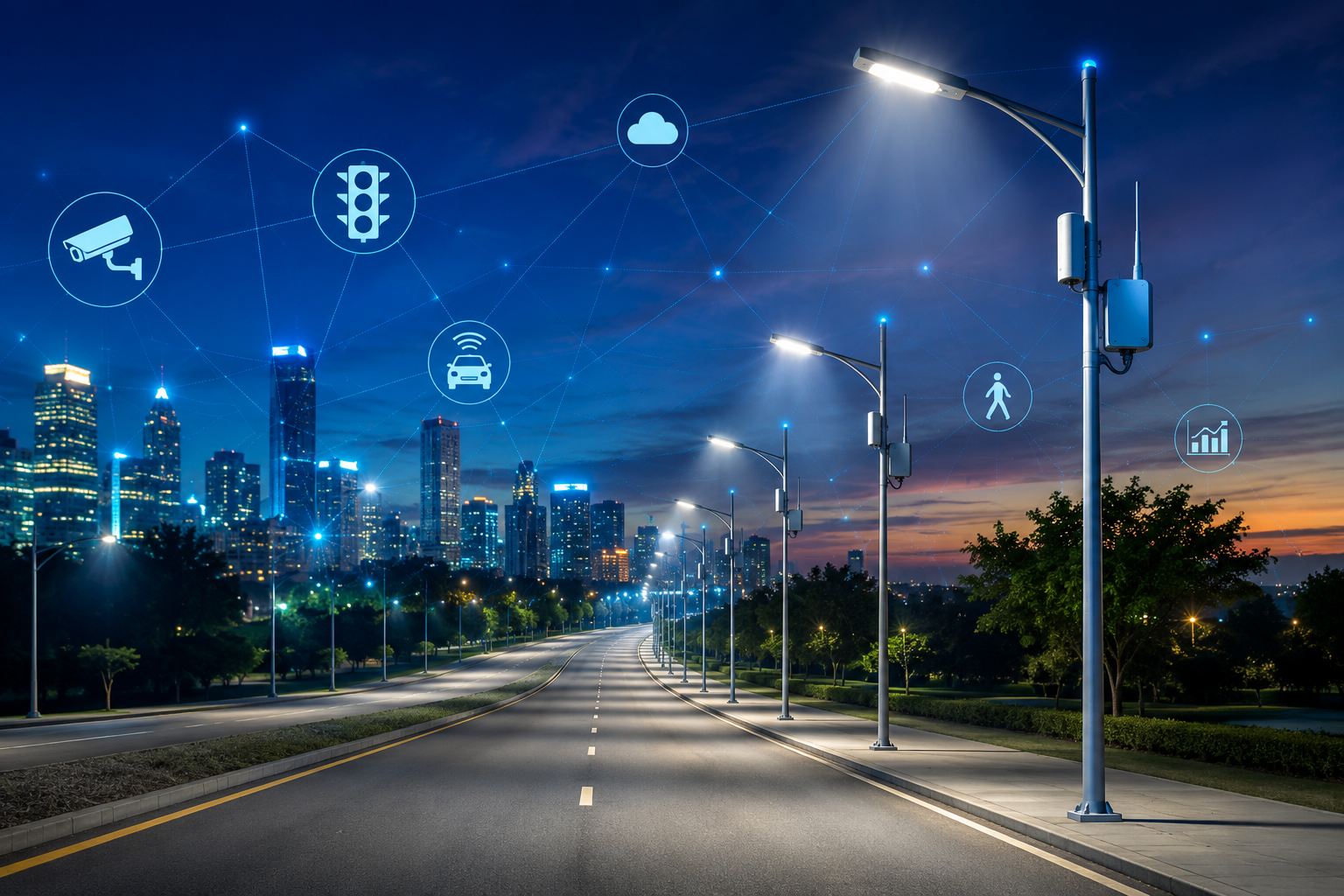
Beyond Burnouts: The Future of Smart Roadway Lighting
As roadway lighting becomes connected, transportation engineering gains a powerful new tool.
Audio Commentary from Author belowArticle Date: July 16th, 2026Flying cars may not be part of our daily commute, at least not yet, but technology has transformed nearly every aspect of modern life over the past few decades. Smartphones have become indispensable, the internet has reshaped how we communicate and work, and artificial intelligence is quickly becoming part of our everyday routines. Consumers have become accustomed to adopting new technologies long before they reach their full potential (insert Apple Intelligence). Features are added through software updates, capabilities continue to expand, and devices often improve long after they've been purchased.
Transportation infrastructure, however, tends to evolve much more quietly. While new consumer technologies often dominate headlines, agencies across the country have been steadily deploying intelligent transportation technologies that make roadways safer, more efficient, and easier to maintain. Collectively known as Intelligent Transportation Systems (ITS), these technologies allow agencies to monitor and manage transportation infrastructure in ways that were unimaginable a short time ago.
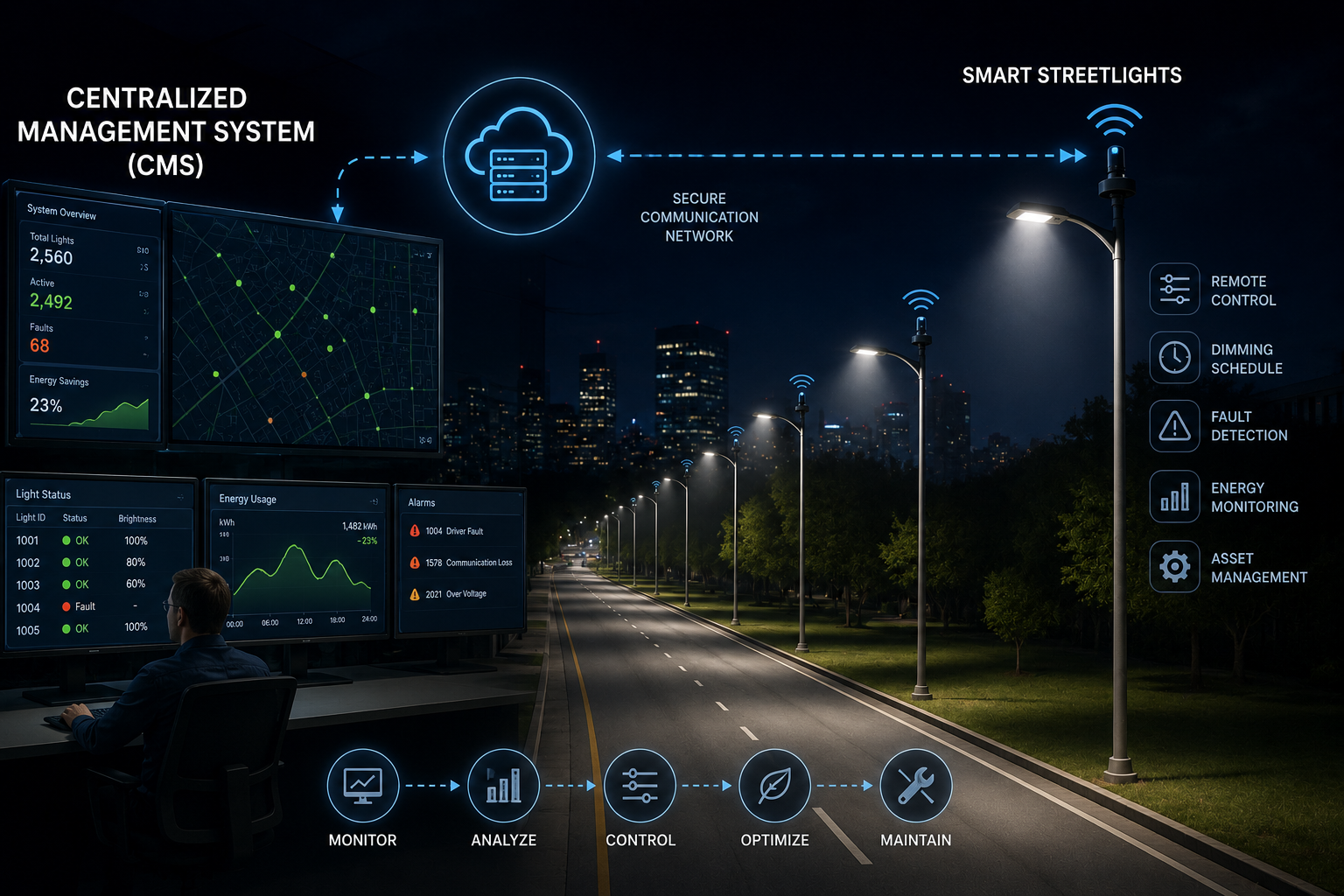
At the center of many of these systems is a Central Management System (CMS), basically the "brain" that communicates with field devices, monitors system health, and issues commands based on changing conditions. With this system, agencies can receive notifications when a streetlight fails before a resident reports it and identify a myriad of issues without sending maintenance crews into the field. The more I visit agencies and see these systems in operation, the more impressed I become with how they are changing the way transportation infrastructure is managed.
Recently, my attention was drawn to the forthcoming ANSI/NEMA C137.13 standard, which introduces a service-based approach to automated fault detection for networked lighting systems. Rather than simply reporting that a luminaire has failed, the concept is to identify the why and the what of the failure. By providing maintenance personnel with more targeted information, repairs become faster, more efficient, and more cost-effective.
Even though this standard is intended to address indoor applications, reading about it led me to think of another question:
What if roadway lighting systems could monitor not only the health of their individual components, but also the performance output of the lighting design itself?
Design intent is established on paper, but once the project is built, countless factors can cause the installed system to perform differently than originally intended. What I am thinking about is maybe there are ways to keep the ‘design intent’ alive throughout the entire life of the system. Imagine receiving an alert that vertical illuminance at a school crossing has dropped below the design objective. Or that tree growth has reduced sidewalk lighting below acceptable levels. Or that multiple fixture outages have degraded visibility at a roundabout enough to warrant immediate lens cleaning or replacements. Instead of simply managing lighting assets, agencies could begin managing visibility performance.
The technology to connect luminaires already exists. The opportunity may be to take the next step using that technology to help agencies prioritize maintenance based not only on equipment failures, but on how those failures affect the safety and performance of the transportation system – the design intent per plan. And maybe that can help with prioritizing repairs, too.
From Traditional Lighting System to Smart Lighting
Roadway lighting has undergone significant changes over the past century, yet its primary purpose has remained the same: to provide safe and reliable nighttime visibility. While lighting technologies have evolved from incandescent lamps to mercury vapor, high-pressure sodium (HPS) to now light-emitting diodes (LED), the basic concept of roadway lighting remained remarkably unchanged for decades.
For many years, the HPS luminaire was the workhorse of roadway lighting. Recognizable by its orange glow, HPS offered a long service life of up to 40,000 hours, and greater energy efficiency than many of its predecessors. The tradeoffs were equally known: slow warm-up times, poor color rendering, and limited visual quality. Despite these shortcomings, HPS reliably accomplished its mission which was basically to light the roadway.
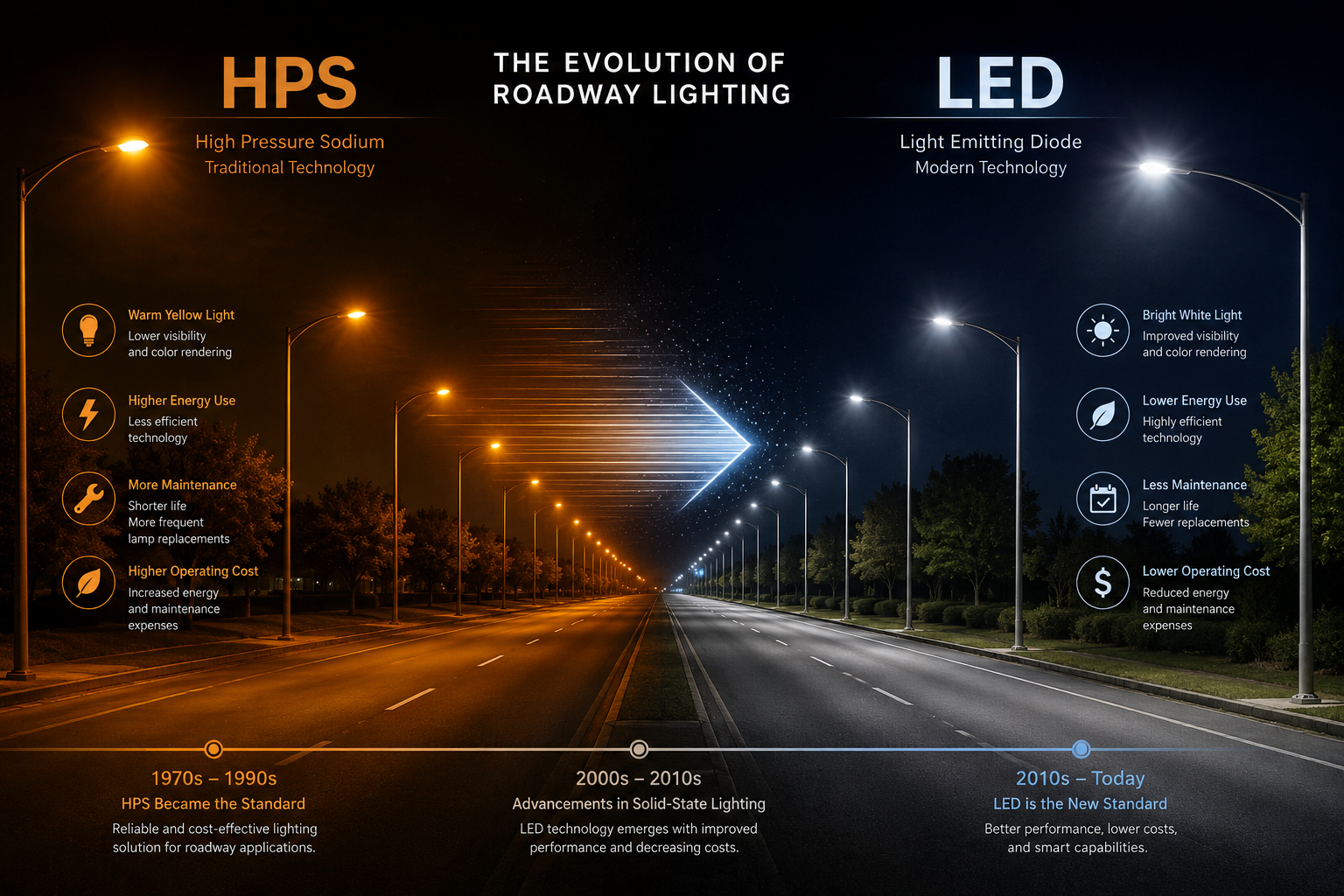
Traditional roadway lighting systems were also fairly simple. A photocell or time clock turned the lights on at dusk and off at dawn, electricity was supplied through utility service, and maintenance was almost entirely reactive, for example, when a luminaire failed, someone noticed and took action. Sometimes it was a resident who reported the outage. Other times, agency staff drove roadways at night searching for burned out lights. Once identified, repairs were added to a maintenance schedule that could take weeks, or even months, to complete. Many agencies still operate this way today.
One of the earliest examples of "smart" lighting wasn't LED technology at all, but it was the photocell. Automatic dusk-to-dawn photocontrols became commercially available during the 1940s and were widely adopted throughout the 1950s and 1960s as mercury vapor and later high-pressure sodium lighting expanded. Before then, many roadway lighting systems relied on manual switching, utility dispatchers, or centralized timers. Imagine having someone responsible for turning thousands of streetlights on every evening and off every morning. The photocell completely changed that by allowing each luminaire to make that decision automatically based on available natural light levels.
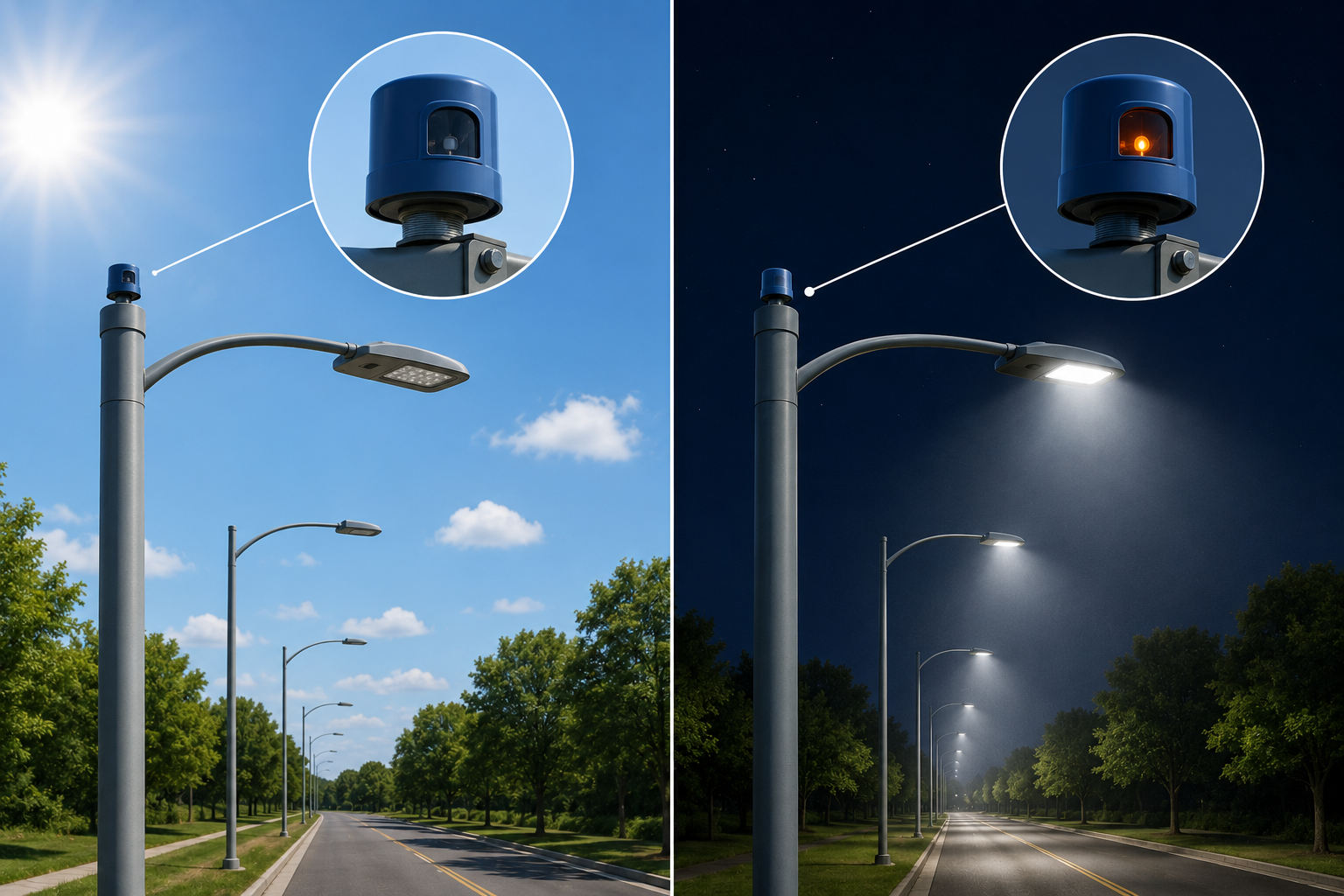
The next major evolution came with LED technology. While LEDs dramatically improved energy efficiency, color quality, and service life, they also introduced something even more transformative: connectivity. Lighting was no longer limited to a simple on-and-off function. It became smart.
Today's smart lighting systems can:
Communicate with a Central Management System (CMS)
Automatically report lighting and electrical faults
Monitor energy consumption
Remotely adjust light output through dimming
Operate using custom schedules
Respond to traffic or pedestrian activity
Integrate with other transportation infrastructure
Receive firmware and software updates
The word smart has become common across many technologies, from smartphones and smart homes to smart cities. In roadway lighting, it simply means the lighting system can sense, communicate, and respond, rather than operating as a stand-alone device. When discussing ITS vs. smart lighting, it is easy to picture them as separate systems, but they essentially operate in the same way. ITS is not a single device or technology, but rather a collection of systems that use sensing, communications, computing, and automation to improve transportation operations, safety, and efficiency. Smart lighting communicates with a Central Management System where it can be monitored, controlled, and analyzed alongside other transportation assets, which makes it a part of ITS technology alongside others:
Traffic signals
Vehicle detection systems
CCTV cameras
Dynamic Message Signs (DMS)
Road weather information systems
Connected vehicle roadside units (RSUs)
Transit signal priority
Ramp metering
Transportation Management Centers
The possibilities extend well beyond maintenance. Today, many smart lighting systems are primarily used to notify agencies of equipment failures or manage energy use. Tomorrow, those same systems could become more active participants in transportation operations. Imagine a CMS that can:
Increase lighting levels during crashes or emergency response.
Brighten pedestrian crossings after major events or stadium departures.
Reduce lighting along low-volume corridors during overnight hours.
Coordinate lighting with weather conditions or variable speed limit systems.
Prioritize maintenance based on the transportation impact of a lighting failure.
From Intelligent Transportation to Intelligent Maintenance
One of the greatest advantages of smart roadway lighting isn't simply that it tells us a light is out; it tells us why. Traditional maintenance was largely reactive. A resident reported a dark street, a maintenance crew discovered a failed luminaire during a nighttime inspection, or an outage happened to be noticed during routine operations. Once identified, crews often arrived at the site without knowing what had failed.
Today's networked lighting systems have changed that process. Instead of reporting a simple outage, the Central Management System can identify the specific issue before a maintenance vehicle ever leaves the yard. Depending on the system, maintenance personnel may receive information such as an LED driver failure or fixture operating during daylight hours. Rather than troubleshooting in the field, crews arrive knowing exactly what equipment they need to replace. The result is less diagnostic time, fewer repeat visits, lower operating costs, and a more reliable lighting system. While these capabilities are certainly impressive from a maintenance standpoint, I believe the real opportunity extends much further.
The transportation engineering practitioner focuses on visibility, safety, operations, and providing a consistent experience for every roadway user. Roadway lighting directly supports these initiatives during the nighttime hours. So, when bringing up the subject of smart roadway lighting, an interesting question is raised:
Can tomorrow's smart roadway lighting systems monitor the health of the transportation service that the equipment supports?
Imagine a Central Management System that can report much more than an electrical fault, one that can also alert an agency that vertical illuminance at a school crossing has dropped below its design objective, that tree growth has reduced pedestrian visibility along a shared-use path, or that multiple fixture failures have significantly degraded visibility at an intersection. Maintenance priorities would no longer be based solely on which luminaire failed, but on where the transportation system is no longer performing as designed. To me, that is where smart roadway lighting becomes much more than an electrical asset.
The Next Evolution
Future performance metrics for smart roadway lighting could include:
Pedestrian crossing visibility
Illuminance reduction detection
Intersection lighting performance
Vertical illuminance estimates
Glare monitoring
Adaptive lighting based on roadway conditions
Weather-responsive lighting strategies
Automatic dimming for energy savings
Connected vehicle integration
This represents more than a technological advancement; it represents a shift in how we think about roadway lighting. The conversation graduates from only maintaining electrical components and towards maintaining transportation performance. Perhaps the next generation of smart roadway lighting won't simply answer the question, "Is the light working?" Instead, it may answer a far more meaningful one:
Is the transportation system still providing the level of visibility it was designed to deliver?
If roadway lighting truly is transportation infrastructure, perhaps that is the question we should begin asking.
References
Authors Notes & Commentary
The perspectives presented in this article are based on the author's professional experience in transportation engineering, roadway lighting design, and field observations of transportation facilities. The article is intended to encourage discussion regarding the role of roadway lighting within transportation engineering practice.