
Discussing the standards that guide the design, and the Human factors that guide the designer.When Standards Meet Reality: The Role of Human Factors in Transportation Design
Audio Commentary from Author belowArticle Date: July 8th, 2026A typical engineering design begins with understanding the project constraints. We open the applicable manuals, review agency standards, and determine what the project must satisfy before a single line is drawn. Those documents are essential as they represent decades of engineering experience and provide the framework for consistent, reliable design.
Too often after construction begins, Requests for Information (RFIs) start arriving, and conditions emerge that were never apparent on the plans. An unanticipated utility conflict, existing trees that affect sight distance, vehicles tracking differently than expected around a curb return, or pedestrians choosing to cross where they feel most comfortable rather than where the crosswalk was placed. The design intent was sound on paper, yet I consistently find that the real world introduces variables that no set of drawings can fully predict. This raises an interesting question:
If a project fully complies with accepted design standards, why do conflicts still occur?
The answer is not that our standards are inadequate. Rather, standards establish a design framework, while human behavior determines how transportation facilities are ultimately used. There will always be interaction between engineering design and human factors, but too often that interaction is evaluated after a facility has been constructed and opened to the public. But here’s a question, what if some of those human factors could be considered much earlier? If a design is to be truly sound and wholistic, human factors should not simply validate our designs after construction, they should help shape them during planning and design.
Why standards exist
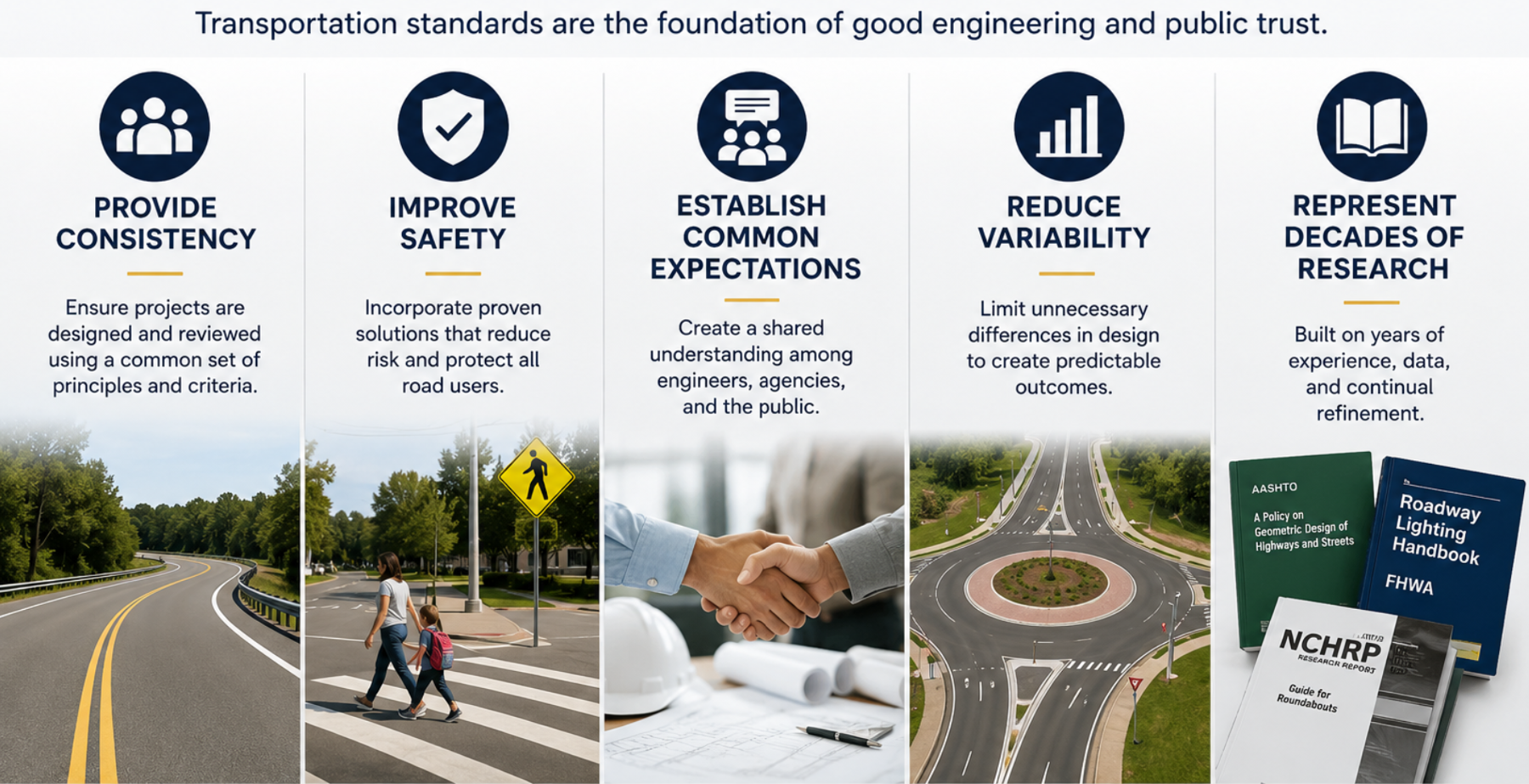
It is important to recognize why engineering standards exist in the first place. Transportation engineering is built upon decades of research, field observations, crash analyses, and lessons learned. Standards are the mechanism by which that collective knowledge is applied consistently from one project to the next. They establish a common language between engineers, agencies, contractors, and reviewers while providing a level of consistency that benefits every road user.
Key Note: Without standards, every project would become an independent experiment.
Design guidance allows engineers to develop facilities with predictable characteristics. All functional structures in the built environment work together because they are built upon common engineering principles. This consistency reduces unnecessary variability and helps create transportation systems that users can better understand and navigate. Standards represent decades of experience, research, and continual refinement, and with that, safety is dramatically improved. When new information becomes available, standards evolve to incorporate those lessons so future projects can benefit from what has already been learned. For these reasons, standards should never be viewed as obstacles to engineering judgment. Rather, they are the essential foundation upon which engineering judgment is exercised.
Human Factors are Dynamic
Transportation systems are ultimately designed for people. While engineering standards often evaluate individual design elements independently, people experience the transportation environment as a single, interconnected system. Every decision a user makes, whether driving, walking, or cycling, is influenced by how they perceive, interpret, and respond to that environment.
Human factors provide the scientific foundation for understanding those interactions. Their importance to transportation engineering cannot be overstated, and perhaps no publication summarizes that role better than (1) NCHRP Report 600: Human Factors Guidelines for Road Systems, which gives an accurate overview as follows:
Human factors is an applied, scientific discipline that tries to enhance the relationship between devices and systems, and the people who are meant to use them. As a discipline, human factors approaches system design with the “user” as its focal point. Human factors practitioners bring expert knowledge concerning the capabilities and limitations of human beings that are important for the design of devices and systems of many kinds. There has been a number of elements within the field of transportation engineering that have benefited from human factors research, including sight distance requirements; work zone layouts; sign design, placement, and spacing criteria; dimensions for road markings; color specifications; sign letter fonts and icons; and signal timing.
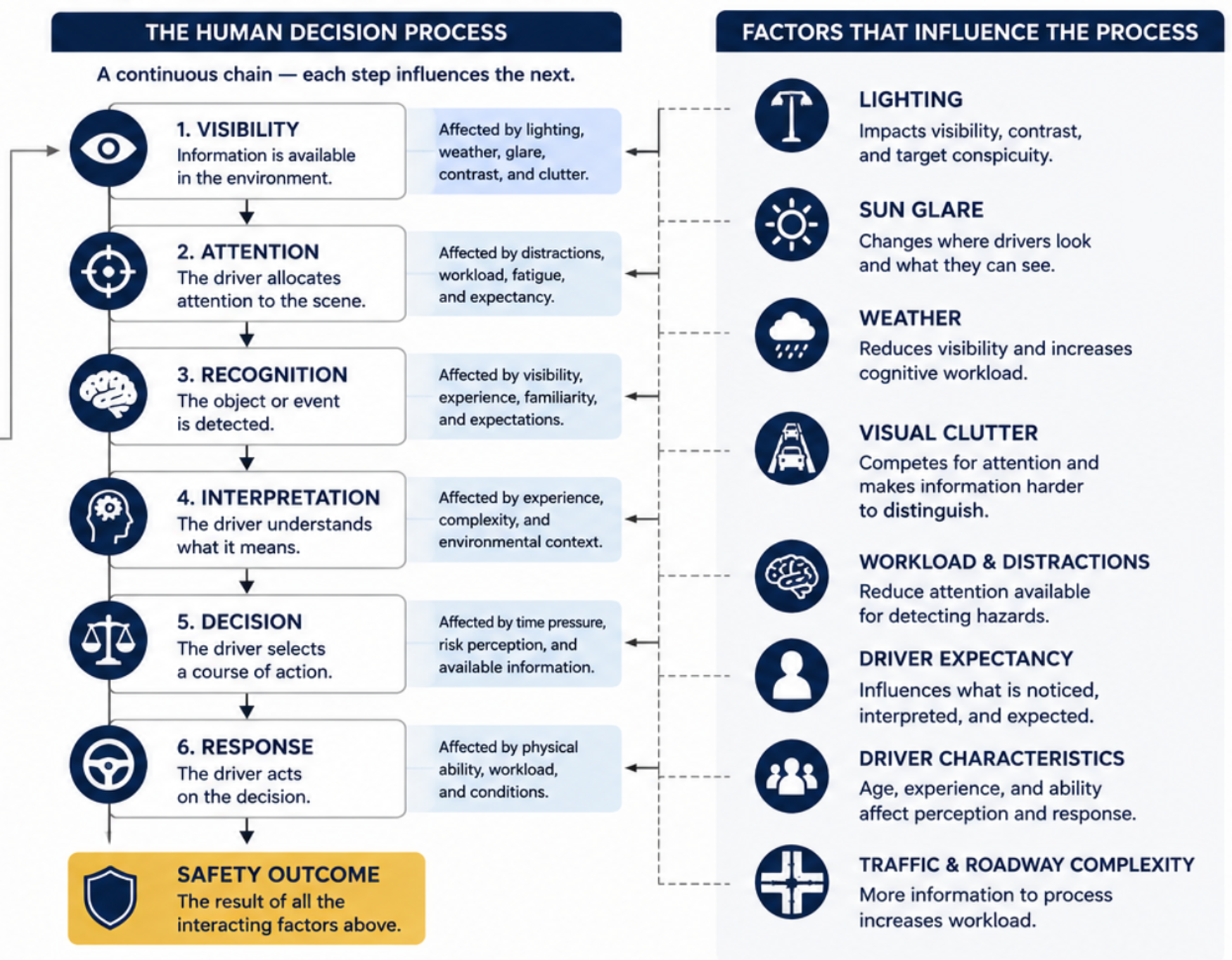
Human factors do not operate in isolation. Each factor influences another continuously throughout the driving task. A small change in one condition can create a chain reaction that affects everything that follows.
For example:
Reduced visibility increases cognitive workload.
Increased workload delays recognition.
Delayed recognition reduces the time available to respond.
Reduced response time decreases the margin for error.
Small delays can ultimately determine whether a conflict becomes a near miss or a crash.
This relationship works in both directions. Improving one element of the transportation environment can improve several others.
Consider a few examples:
Better lighting improves target conspicuity, reducing search time.
Sun glare changes where drivers naturally direct their attention.
Driver expectancy influences what hazards are noticed and which ones are overlooked.
Visual clutter competes for limited attention.
Complex intersections increase cognitive workload.
Fatigue, age, weather, and distractions all influence how information is processed.
Another interesting Human Factors Concept worth mentioning is inattentional blindness, which is the tendency to fail to notice an otherwise visible object because attention is focused elsewhere. In transportation, this means a pedestrian, bicyclist, warning sign, or even a traffic signal can exist within a driver's field of view and still go unnoticed. Unfortunately, the risk of this factor is immense. My family once owned a silver Chevrolet TrailBlazer, and on numerous occasions other drivers turned directly in front of us as if they had not seen us. This raised an interesting question: did the vehicle's silver paint and dark bumper reduce its conspicuity against the pavement under certain conditions? Experiences like this remind me that people do not respond only to geometry and traffic control, they respond to what they actually perceive.

Whether something is noticed depends on where attention is directed, what the driver expects to see, the surrounding visual complexity, and the workload required to process the scene. This is why transportation engineering increasingly benefits from a human-centered perspective. Designing for visibility is not simply about making objects brighter or increasing sight distance. It is about understanding how people detect, recognize, interpret, and respond to information under real-world conditions.
Engineering Judgement
Engineering judgment determines how standards are applied to the unique conditions of each project. No two transportation facilities are exactly alike. Two intersections may share the same geometry, traffic volumes, and control devices, yet differ dramatically in the way people interact with them. Surrounding land uses, driver expectancy, demographics, weather, lighting, pedestrian activity, and countless other factors create a unique operating environment for every location.
Experienced engineers routinely evaluate conditions that extend beyond the minimum requirements of a manual. They ask questions that standards cannot always answer.
How will drivers actually experience this location?
Where will their attention naturally be directed?
What human factors could influence their decisions?
Are there conditions that warrant additional consideration?
These questions do not replace standards but complement them. Engineering judgment is not permission to ignore established guidance. Rather, it is the responsibility to recognize when unique site conditions deserve additional evaluation. Standards provide consistency across thousands of projects, while engineering judgment allows each project to respond to the conditions that make it unique.
As transportation systems become increasingly complex, the importance of engineering judgment only grows. Human behavior, visibility, and operational performance cannot always be reduced to a single design value or warrant. They require observation, experience, and an understanding of how people interact with the built environment.
Standards establish the foundation. Engineering judgment determines how that foundation is applied to the real world.
Engineering Beyond the Manual
The design manuals transportation engineers follow represent decades of research, experience, and lessons learned, providing consistency across thousands of projects. They tell us what has generally been shown to work. But every project is ultimately built for people, and no two transportation environments are exactly alike. Human behavior, visibility, weather, demographics, land use, and countless other factors create unique conditions that cannot always be reduced to a single design value or warrant.
Perhaps the future of transportation engineering is not simply writing better standards. Perhaps it is becoming better at understanding the people those standards are intended to serve.
Standards provide consistency. Human factors provide context. Engineering judgment brings them together to create transportation systems that are not only compliant, but truly effective.
References / Citations
(1) Transportation Review Board NCHRP Report 600: Human Factors Guidelines for Road Systems https://highways.dot.gov/safety/pedestrian-bicyclist/safety-tools/pg-22-9-22-34-nchrp-report-600-human-factors-guidelines
Author’s Notes & Commentary
The perspectives presented in this article are based on the author's professional experience in transportation engineering, roadway lighting design, and field observations of transportation facilities. The article is intended to encourage discussion regarding the role of roadway lighting within transportation engineering practice.