
Exploring the transportation impacts of sun glare, daylight visibility, and human factors.
The Visibility Challenges of Daylight
Audio Commentary from Author belowArticle Date: July 1st, 2026About a week ago, a horrific crash occurred less than a mile from my house. A pedestrian, out for what should have been a routine morning walk, was struck and killed while using the crosswalk at a stop-controlled intersection by a driver making a left turn. From a transportation design perspective, nothing about the intersection immediately stands out as wrong. It is in a residential community with relatively low speeds, a single lane in each direction with a dedicated left turn lane. At first glance, there appears to be no obvious design deficiency.
Then one detail from the preliminary police report caught my attention: sun glare.
At approximately 7:30 on a summer morning, the rising sun is typically positioned directly in the path of approaching drivers making the left turn. While the investigation will ultimately determine all of the contributing factors, it immediately reminded me of something I have personally experienced.
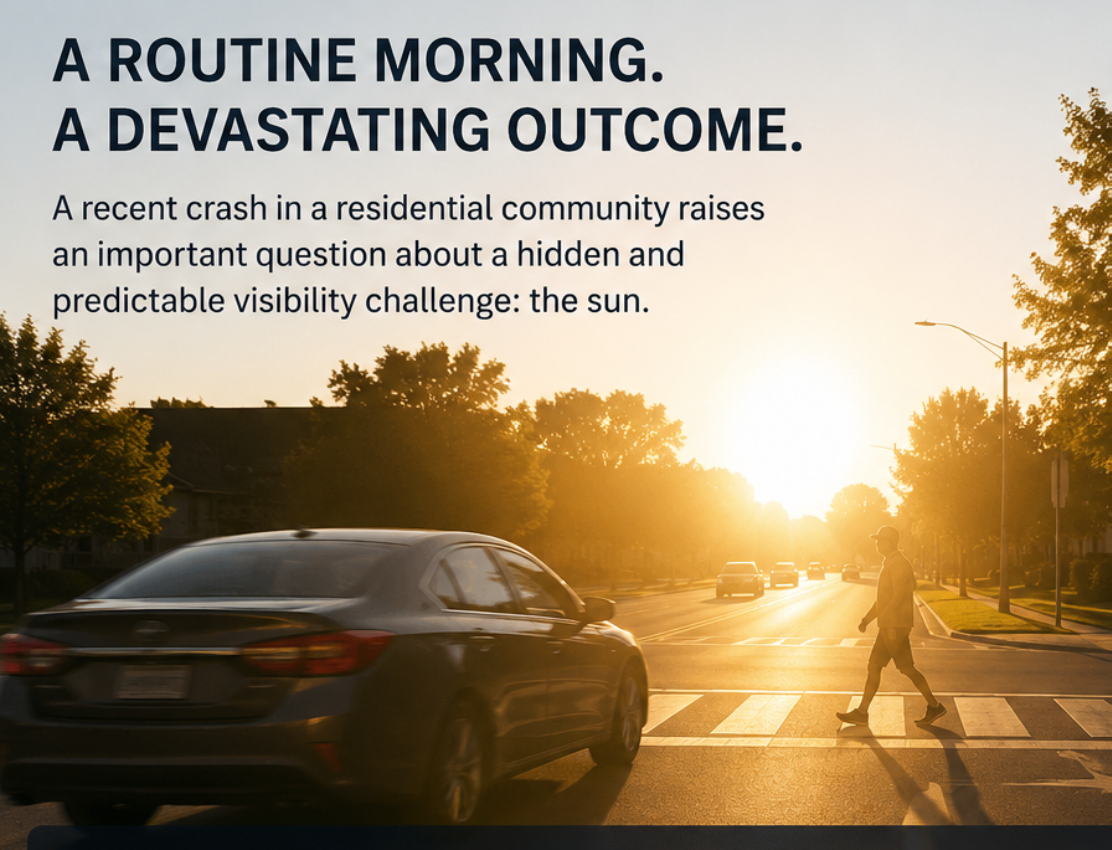
Years ago, my wife and I approached an intersection under similar conditions. Sitting in the passenger seat, I noticed a pedestrian preparing to cross and pointed them out. My wife did not see the pedestrian until I mentioned it. The low morning sun had reduced the pedestrian's visibility just enough that they blended into the background.
That experience, combined with the recent crash, led me to a question worth exploring:
How much attention should we give to visibility challenges created by the sun?
The Sun’s Function as a Transportation Lighting Source
At night, artificial lighting is something engineers can largely control. We can determine where luminaires are placed, how much light they produce, where that light is directed, and the level of illumination reaching the roadway or pedestrian. Natural lighting is different. While we cannot control the position of the sun, we can understand how it interacts with the transportation environment and where it may create predictable visibility challenges. Perhaps the most significant of those challenges is sun glare.
When the sun is low on the horizon and positioned directly within a driver's field of view, it can dramatically reduce the ability to detect and recognize important information. A pedestrian in a crosswalk, a bicyclist, a traffic signal, or even another vehicle can suddenly become much more difficult to distinguish. The issue is not a lack of light, but too much light in the wrong place. And this is not simply an inconvenience. Research has shown that bright sunlight conditions are associated with an increased risk of severe motor vehicle crashes. A study published through the National Library of Medicine, which examined life-threatening injury crashes over a period of nearly two decades, found a measurable increase in crash risk during bright sunlight conditions. While many factors contribute to a collision, the findings reinforce what many drivers have experienced firsthand: under certain conditions, the sun can become a significant transportation visibility hazard.
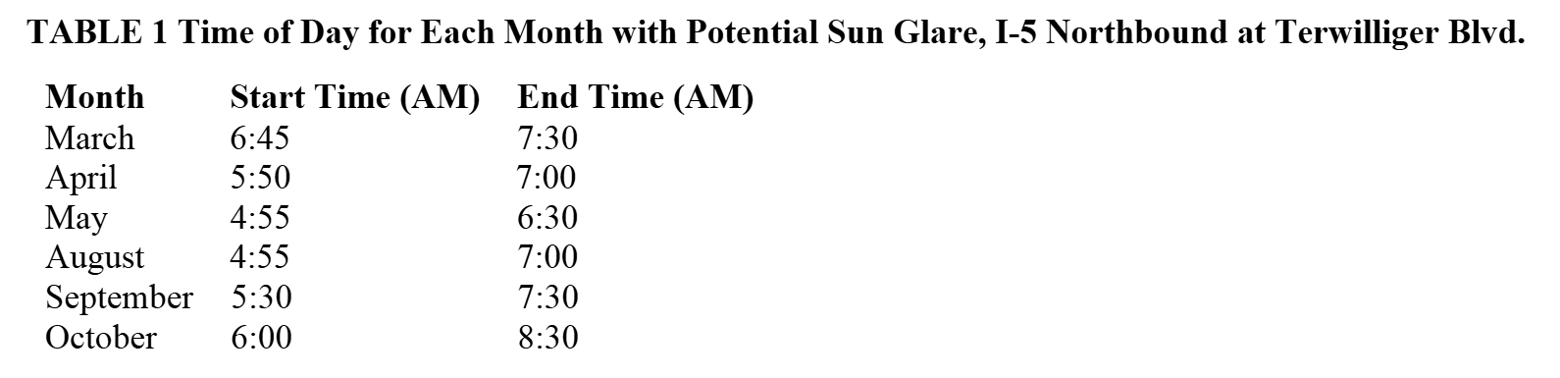
Sun glare is most associated with sunrise and sunset, when the sun is positioned low on the horizon and more likely to fall directly within a driver's field of view. Because the sun's angle changes throughout the year, the duration and severity of glare can vary considerably from season to season. Researchers have studied this phenomenon as well. A paper published through the Transportation Research Board developed a method for identifying periods when sun glare is likely to affect drivers based on solar position. The authors explain:
"(2)Given the wide variation in vehicle and driver characteristics that could possibly cause glare issues, sun angles between 0° (sunrise) and 15° were chosen as a reasonable range to demarcate possible glare time intervals."
This is an important observation because it demonstrates that sun glare is not entirely random. By understanding solar position, transportation professionals can begin identifying locations and times where visibility challenges are more likely to occur.
Findings from an FHWA Road Safety Audit case study provide an excellent illustration of the effects that sun glare can have on driver visibility. As shown in (1)Figure 11 below, the low morning sun dramatically reduces contrast throughout the driver's field of view. Under these conditions, pedestrians, vehicles, pavement markings, and even traffic signal indications become much more difficult to distinguish.
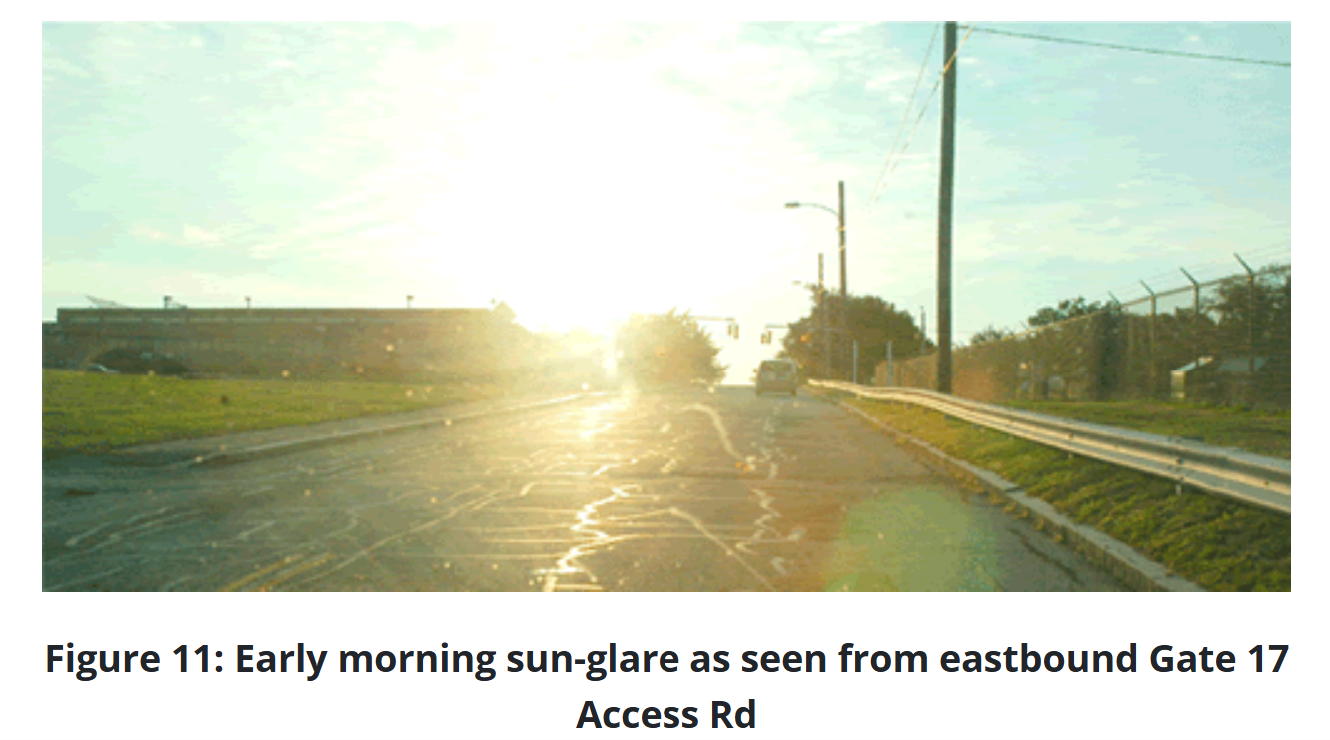
This is a classic example of disability glare. Rather than a lack of illumination, the driver's vision is overwhelmed by excessive brightness from a low-angle light source. The result is a significant reduction in the ability to detect, recognize, and interpret critical information within the roadway environment.
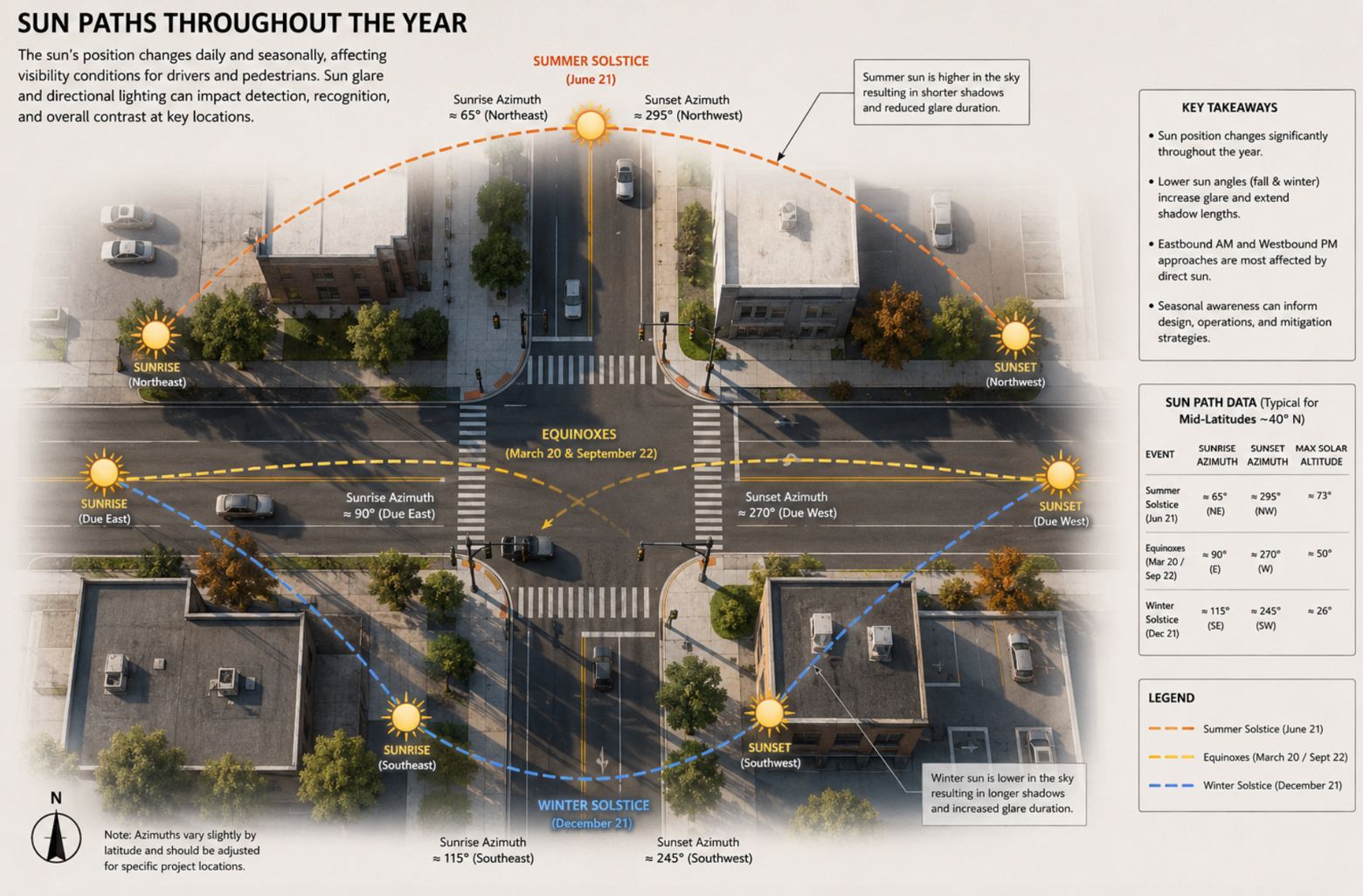
Fortunately, these conditions typically occur only during relatively short periods around sunrise and sunset. However, their limited duration should not diminish their importance. As the recent crash discussed earlier illustrates, even a brief period of reduced visibility can have devastating consequences. During the planning and design stages of a project, it is entirely possible to evaluate how the sun may influence visibility at a site. While the sun's position changes throughout the year, its path is predictable. Readily available solar data can be used to understand when and where drivers may experience disability glare throughout different seasons. An initial review can begin with something as simple as a site diagram, evaluating roadway orientation, travel direction, and seasonal solar position. Existing and proposed features including buildings, trees, and other structures should also be considered, as they may either shield drivers from glare or expose them to it.
Attention should be given to locations where predictable conflicts already exist, including both signalized and unsignalized intersections, eastbound approaches during sunrise, westbound approaches during sunset, left-turn movements, crosswalks, school crossings, and areas with high pedestrian activity. The objective is not to eliminate every instance of sun glare, but rather to recognize where predictable visibility conflicts may occur and determine whether engineering, operational, or planning decisions can help reduce their impact.
Human Factors
While the sun creates the environmental condition, it is the human driver who experiences its effects. Understanding how the human visual system responds to bright sunlight is just as important as understanding the roadway itself.
Text taken from the FHWA Roadway Visibility Research Needs Assessment notes that:
(3)"Approximately 90 percent of the information that drivers use is visual. For nighttime driving, two of the most important factors affecting vision are visual acuity and contrast sensitivity. Visual acuity is the ability to discern details at a distance, while contrast sensitivity is the ability to distinguish an object from its background.”
Although this statement is presented in the context of nighttime driving, the same principles apply during the day. Bright sunlight can reduce the driver's ability to perceive important information by overwhelming contrast and creating disability glare. Unlike artificial lighting, we cannot control where the sun is positioned or how intense it will be. Weather conditions, seasonal changes, atmospheric conditions, and roadway orientation all influence how drivers experience natural light. Because these conditions vary, transportation engineers should understand not only the transportation environment, but also how the human visual system responds to it.
Research published through the National Library of Medicine reinforces this relationship between vision and driving performance:
(1)"Safe driving relies on vision (with lesser contributions from auditory, tactile, and vestibular feedback). (5)Visual illusions, however, predispose healthy people to recurrent mistakes when judging size, position, and motion. (6)Judgments about distance, in particular, rely heavily on aerial perspective (also called the Rayleigh effect or atmospheric scattering) where clear bright objects appear close and dim faded objects appear distant.”
The paper explains that visual perception influences how drivers judge the size, position, distance, and movement of objects. Under glare conditions, these judgments become more difficult, increasing the likelihood that critical roadway information, or vulnerable users such as pedestrians and bicyclists, may not be recognized in time. As indicated in other articles in this series, the human factors process details the period where visual perception is critical:
Detection: Can the driver see that something is present?
Recognition: Can the driver identify what it is?
Interpretation: Can the driver correctly understand the situation?
Response: Does the driver have adequate time to react safely?
Sun glare has the potential to interrupt each of these stages. Understanding that relationship is the first step toward identifying locations where predictable visibility conflicts may occur.
Detection/Recognition
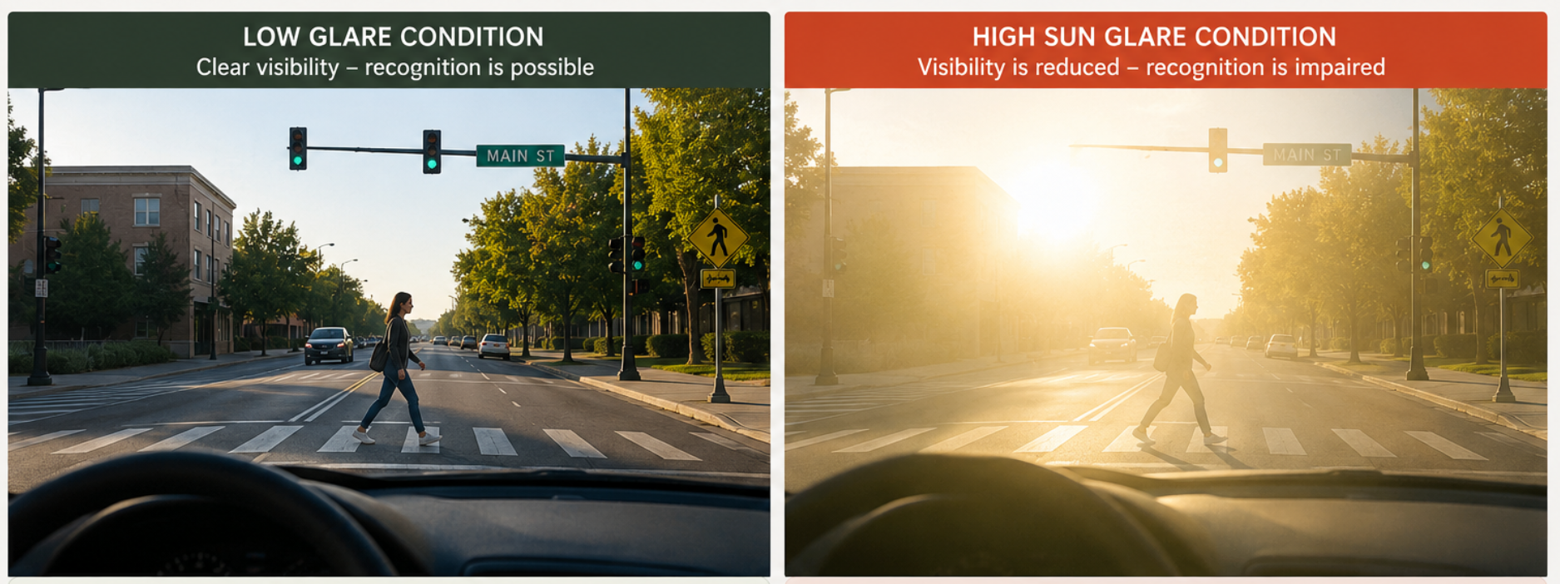
Recognition is one of the most important aspects of human factors. Simply put, once a driver can recognize what they are seeing, they can make an informed decision about how to respond. When recognition is impaired, response time is reduced and the likelihood of an incorrect decision increases. Sun glare can significantly affect this recognition process by reducing contrast and overwhelming the driver's visual field. Under severe glare conditions, pedestrians, bicyclists, vehicles, traffic signals, and other critical roadway information can become difficult or in some cases impossible to distinguish from the surrounding environment.
Pedestrians are particularly vulnerable because they occupy a relatively small visual target and often have limited contrast against a bright background. Even when a pedestrian is legally crossing within a marked crosswalk, sun glare may delay or prevent a driver from recognizing their presence in time to react safely. The illustration below compares the same intersection under normal viewing conditions and under significant sun glare. Although the traffic signal remains visible, being a green light, the pedestrian becomes much more difficult to recognize. The purpose of this example is not to suggest that every glare condition results in a collision, but to demonstrate how quickly a driver's ability to recognize critical information can deteriorate when the sun is positioned directly within the field of view.
Interpretation
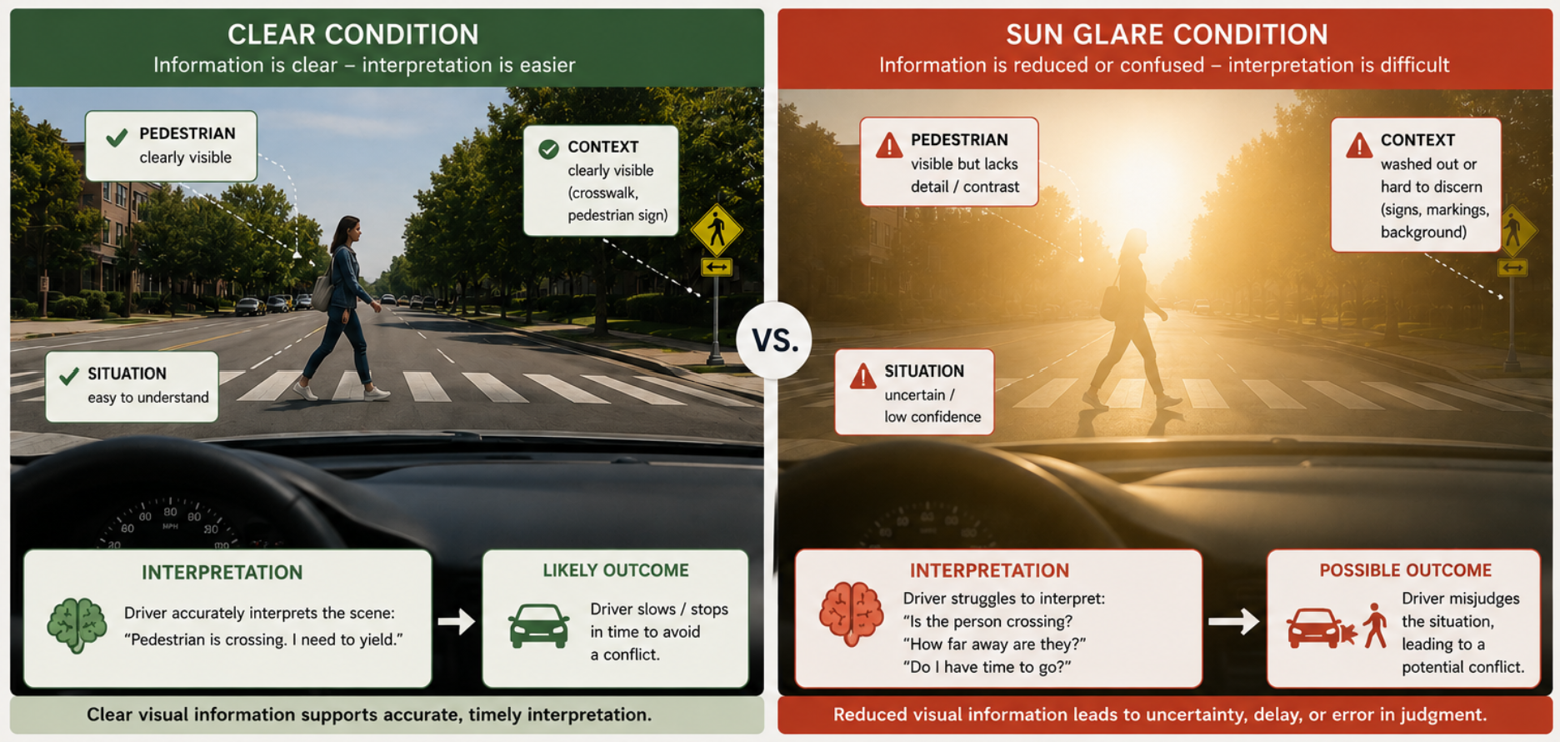
Once a driver detects and recognizes what they are seeing, the next step is interpretation. This is the process of understanding what that information means and deciding whether action is necessary.
For example, after recognizing a pedestrian, a driver must quickly interpret several pieces of information at once:
Is the pedestrian walking toward the roadway or away from it?
Do they intend to cross?
How fast are they moving?
Where will they be in the next few seconds?
What is the traffic signal indication?
Based on my speed, do I need to brake or can I safely continue?
Sun glare can complicate this process by reducing the clarity of the visual scene. Even if a pedestrian has been detected and recognized, determining their exact position, movement, or intention becomes more difficult when portions of the roadway environment are washed out by bright sunlight. This is where roadway orientation becomes particularly important. Eastbound roadways during sunrise and westbound roadways during sunset create predictable conditions where low-angle sunlight may interfere with a driver's ability to correctly interpret the roadway environment. Recognizing these locations during planning and design provides another opportunity to reduce potential visibility conflicts.
Response
The final stage of the visibility process is response. After detecting, recognizing, and interpreting the roadway environment, the driver must decide how to react. That response may be as simple as easing off the accelerator, applying the brakes, steering away from a hazard, or stopping altogether. Every stage leading up to this point influences the amount of time available to respond. If a pedestrian is not detected until the last moment because of sun glare, there is less time to recognize the situation, interpret what is happening, and ultimately react safely. In many cases, the driver's response is not limited by vehicle performance, it is limited by the amount of information available and the time remaining to process it.
Age is another important human factor. Research has shown that older drivers are generally more susceptible to glare and often require more time to recover from bright light exposure. Communities with larger older populations, retirement developments, medical districts, or areas with a high percentage of senior drivers may warrant additional consideration when evaluating predictable sun glare conditions.
Ultimately, improving response begins much earlier in the visibility process. By helping drivers detect, recognize, and correctly interpret the roadway environment sooner, transportation engineers can increase the time available to make safe decisions.
Predictable Problem Locations
Certain conditions are predictable with regards to potential sun glare issues:
Eastbound approaches at sunrise
Westbound approaches at sunset
Left-turn movements
Signalized intersections
Crosswalks
School crossings
The question becomes:
Can we identify these problem locations before crashes occur?
Visibility Mitigation Strategies
After understanding how the sun influences detection, recognition, interpretation, and response, the next question becomes:
Can transportation engineers do anything about it?
In many situations, the answer is yes.
The objective is not to eliminate sun glare. That would be impossible. Rather, the goal is to recognize where predictable visibility conflicts are likely to occur and determine whether engineering, operational, or planning decisions can reduce their impact.
Nighttime visibility often receives significant attention because it requires the intentional design of artificial lighting. Daytime visibility, however, is frequently assumed to be adequate simply because the sun is providing illumination. While this is true under many conditions, sunlight itself can become a visibility challenge depending on the roadway orientation, time of day, season, weather, and surrounding environment. Considering how the sun interacts with a transportation facility is simply another opportunity to improve visibility and reduce conflict.
Potential Mitigation Strategies
Mitigation strategies will vary depending on the project, but considerations may include:
Evaluate eastbound approaches during sunrise and westbound approaches during sunset.
Consider seasonal solar position during site planning and roadway layout.
Restrict turning movements where recurring glare-related conflicts have been identified.
Evaluate protected left-turn phasing where pedestrian activity overlaps with low-angle sunlight.
Consider pedestrian leading intervals to improve pedestrian conspicuity before turning vehicles proceed.
Review signal visibility, including the use of retroreflective backplates where appropriate.
Consider building orientation and site layout to minimize recurring glare conflicts.
Review façade materials or reflective surfaces that may create secondary glare.
Evaluate roadway curvature, grading, and vertical alignment that may increase direct sun exposure.
Consider landscaping that provides shading without creating sight distance concerns.
Minimize shadow patterns that may reduce pedestrian conspicuity.
Evaluate refuge islands or crossing treatments where pedestrian exposure is high.
Consider locations with high visual workload, such as major intersections or school zones.
Document recurring glare conditions during Road Safety Audits and post-construction safety reviews.
Developing Solar Awareness
Perhaps the greatest opportunity exists during planning, when changes are least expensive and design flexibility is greatest. Rather than waiting until construction documents are underway, project teams can begin asking a few simple questions early in the process:
Will eastbound traffic experience direct sunrise glare?
Will westbound traffic experience direct sunset glare?
Will left-turn movements routinely face low-angle sunlight?
Is this school crossing busiest when the sun is lowest?
Will this transit stop be backlit during peak commuting periods?
Are there buildings, retaining walls, or reflective façades that could amplify glare?
Can the site layout be adjusted before it becomes fixed?
These questions do not require extensive analysis to begin the discussion. They simply encourage project teams to recognize that the sun is another predictable element of the transportation environment.
Beyond Nighttime: Solar Visibility Considerations in Transportation Engineering
Transportation engineers cannot change the position of the sun, but they can recognize where solar visibility is likely to influence driver performance and consider whether planning, operational, or engineering decisions can reduce those conflicts. Research, crash investigations, and everyday driving experience all point to the same conclusion: low-angle sunlight can significantly impair visibility. Because these conditions are predictable, they deserve intentional consideration throughout the planning and design process and not simply after crashes occur.
Visibility should not be viewed as a nighttime issue alone. During the day, the sun becomes the primary source of illumination, and under certain conditions it can also become the primary source of visual impairment. Designing transportation systems that acknowledge both realities is part of designing for safety. Perhaps the greatest opportunity lies in asking better questions earlier. Could roadway orientation be adjusted? Are left-turn conflicts likely during sunrise or sunset? Will school crossings or transit stops experience recurring glare? Can operational strategies reduce exposure during predictable periods of risk? These questions cost little to ask during planning, but they may have a lasting influence on safety.
As transportation engineers, we routinely predict traffic demand, operational performance, and future mobility needs. Predicting how the sun will interact with those transportation systems is simply another opportunity to improve visibility for everyone who uses them.
Visibility does not begin when the lights turn on. And it does not end when the sun comes up.
References / Citations
(1)National Library of Medicine: Life-threatening motor vehicle crashes in bright sunlight September 2013-Paola Bressan, Luigi Garlaschelli, Monica Barracano Life-threatening motor vehicle crashes in bright sunlight - PMC
(2)An Empirical Investigation of the Impacts of Sun-Related Glare on Traffic Flow - December 2007 - Benjamin Auffray, Christopher M. Monsere, Robert L. Bertini (PDF) An Empirical Investigation of the Impacts of Sun-Related Glare on Traffic Flow
(3)FHWA: Road Safety Audit Case Studies: Using Three-Dimensional Design Visualization in the Road Safety Audit Process Apendix A: Case Studies July 2013
FHWA-SA-14-003 Dan Nabors, Jon Soika Appendix A: Case Studies | FHWA
(4)FHWA: Roadway Visibility Research Needs Assessment – Current Research and Practices December 2016 FHWA-SA-17-031 - Travis Terry, Brad Brimley, Ronald Gibbons, and Paul J. Carlson Roadway Visibility Research Needs Assessment | FHWA
(5)Owsley C, McGwin G. Vision and driving. Vis Res 2010;50:2348–61. Vision and Driving - PMC
(6)Bressan P, Garlaschelli L, Barracano M. Antigravity hills are visual illusions. Psychol Sci 2003;14:441–9. Antigravity hills are visual illusions - PubMed
Authors Notes & Commentary
The perspectives presented in this article are based on the author's professional experience in transportation engineering, roadway lighting design, and field observations of transportation facilities. The article is intended to encourage discussion regarding the role of roadway lighting within transportation engineering practice.