
Exploring how planning decisions influence visibility outcomes long before lighting design begins.Visibility Begins with Planning
(Audio Commentary from Author Below)Article Date: June 23rd, 2026A new planning objective?
Over the last few years, I have noticed an increase in requests for conceptual lighting plans early in the development process, particularly during the entitlement stage. Agencies appear to be thinking about lighting sooner, resulting in developers bringing lighting consultants onto projects earlier than what has traditionally been the norm. It is interesting because I’ve been much more accustomed to designing exterior site and roadway lighting during the construction documents phase. Representing a seemingly growing trend, lighting seems to be getting more attention for its importance in delivering safety, comfort, and security at night, and perhaps the benefits of early planning are being recognized as well.
I've always viewed transportation planning as being ahead of the game, helping shape transportation systems years before the design team prepares the first set of construction documents. Early in my career, I would often see projects move from the planning department to the design department and think, "I've seen this project before." While the engineering designers were focused on implementation, transportation planners had already spent years considering how people would move through that future environment.
As I mentioned earlier, lighting traditionally enters a project much later in the development process. However, for the remainder of this discussion, it may be helpful to view lighting as just one of many tools that can influence visibility outcomes. Visibility itself is broader than lighting, encompassing how users detect, recognize, interpret, and respond to the transportation environment. Once roadway geometry is established, pedestrian facilities are located, and site layouts are largely finalized, lighting designers are brought in to develop photometric calculations, determine pole locations, and prepare plans. As visibility considerations continue to move earlier into project development, an interesting question began to emerge:
What would the benefits be if visibility-related decisions were intentionally considered long before the actual lighting design begins?
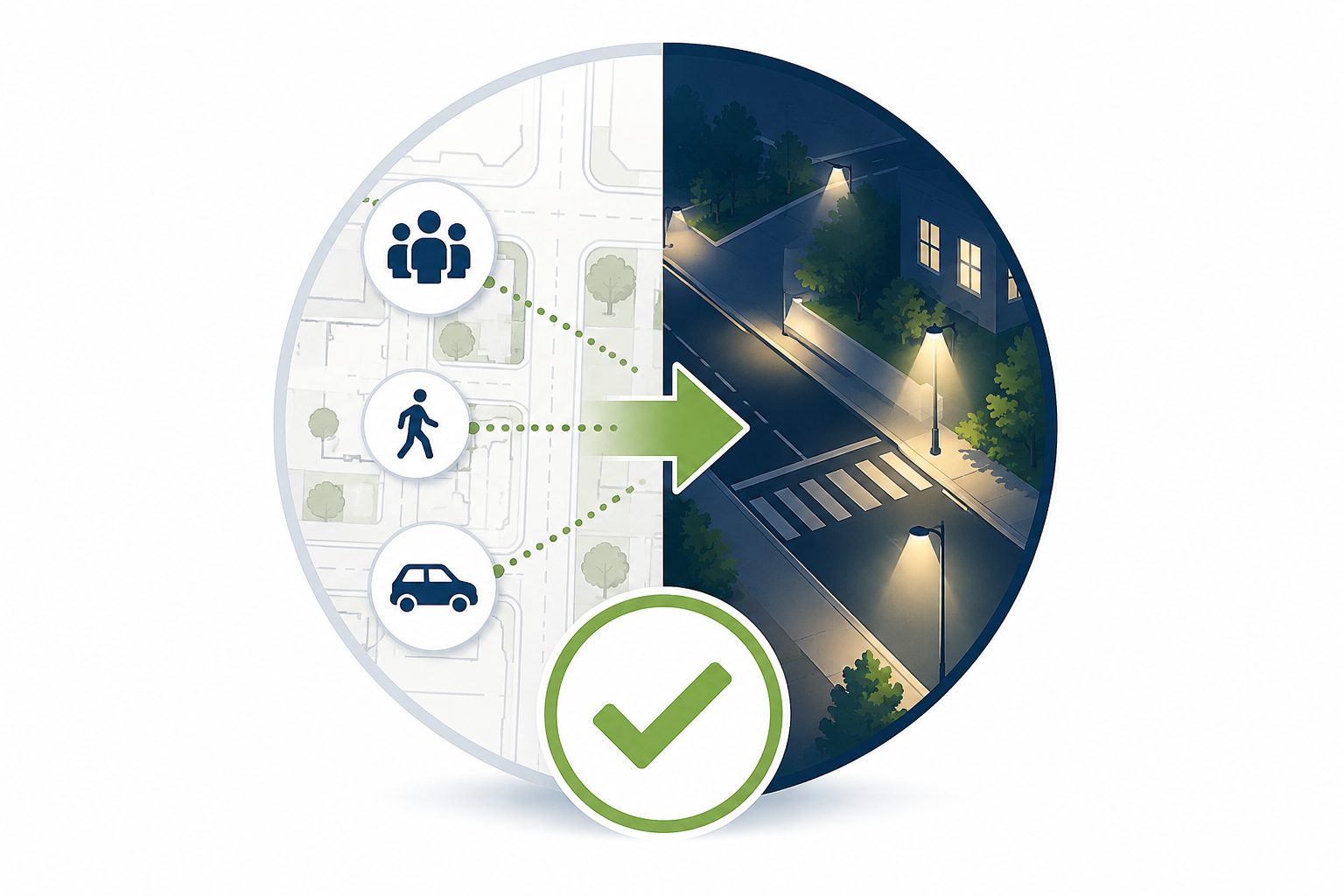
The common questions we ask during the planning stage also have a direct relationship to visibility:
· Who will use this space?
· When will it be used?
· Where are pedestrians likely to travel?
· Where might conflicts occur?
· Which areas should receive greater emphasis?
While these questions are often asked from the perspective of transportation operations, mobility, accessibility, and safety, they can also help establish visibility objectives. The answers begin to reveal where users are expected to be, how they are likely to move through an environment, and where visibility may become most important.
Visibility is rarely an isolated issue. It is influenced by land use, circulation patterns, user behavior, architecture, landscaping, and countless other decisions that are routinely made during planning. As a result, many visibility outcomes are already beginning to take shape long before the first lighting calculation is ever performed. Visibility has been present as a transportation consideration all along, but one that has not always been explicitly identified and carried forward into design.
Visibility Planning for the Demographic
Transportation planners routinely consider the people who will ultimately use a transportation system. Demographics, land use, housing density, transit access, and multimodal connectivity all help predict how a community is likely to move. These considerations influence countless planning decisions long before detailed design begins.
If future user behavior can be anticipated, an interesting question emerges:
Can future visibility needs be anticipated as well?
Different land uses generate different transportation behaviors. A suburban residential neighborhood may experience very different nighttime activity than a mixed-use development, entertainment district, transit-oriented community, or university campus. In many cases, planners can reasonably anticipate where pedestrian activity is likely to occur, where vulnerable users may be present, and where conflicts are more likely to develop.
This concept is not entirely new. The FHWA's Nighttime Visibility for Safety initiative identifies locations such as schools, parks, transit stops, and entertainment districts as areas where visibility improvements can provide meaningful safety benefits. The common thread among these locations is not only the lighting design itself, but the recognition that certain land uses generate predictable human activity and visibility needs.
Consider a convenience store located adjacent to a multifamily residential development. Even when a formal crossing is provided, planners understand that pedestrians will often choose the most direct or convenient path available. The objective is not to predict every individual movement, but rather to recognize where pedestrian activity is likely to occur and ensure those areas receive appropriate visibility consideration.
Key Point to Highlight: Visibility emphasis should follow expected human activity.
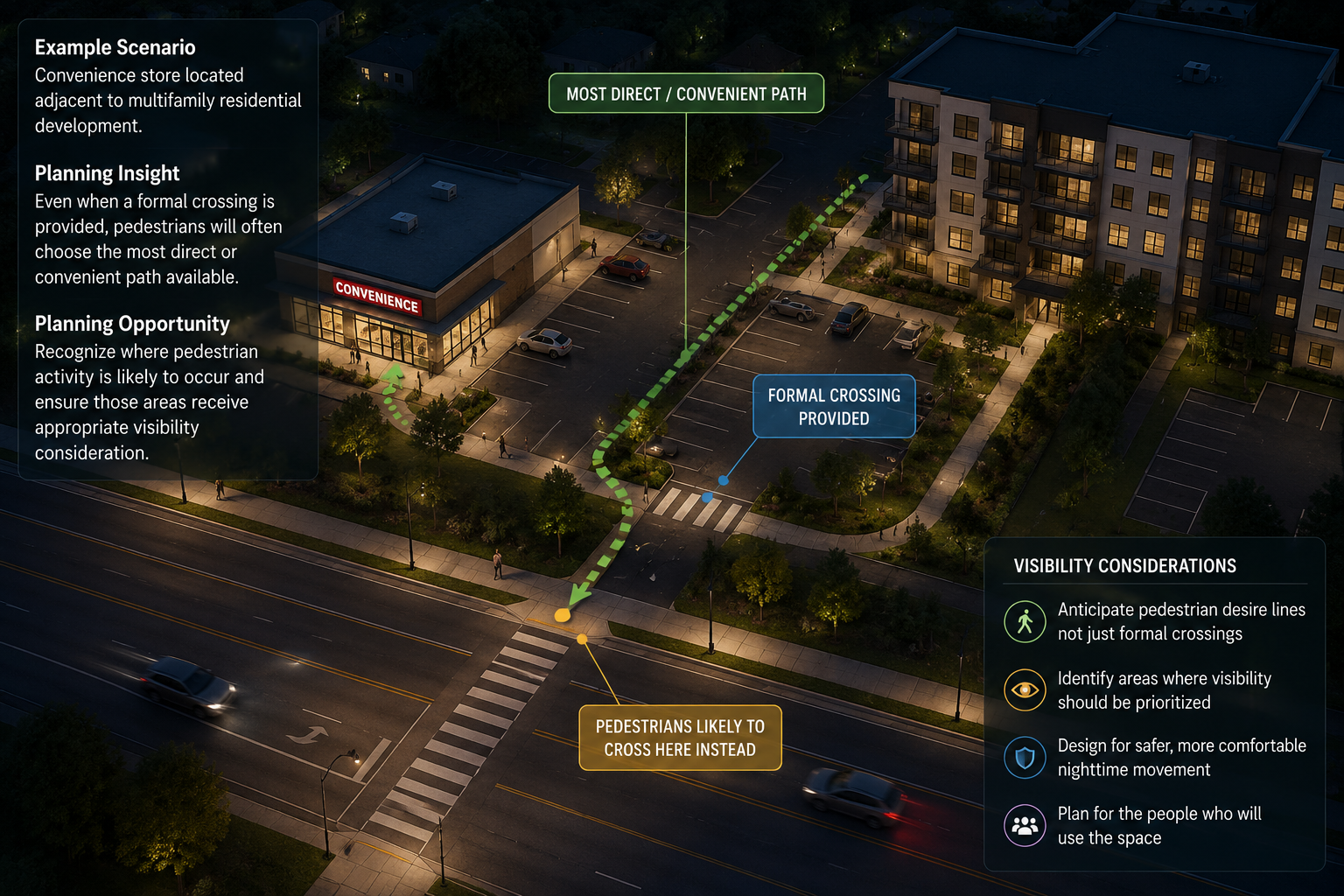
If transportation planners can reasonably anticipate future travel patterns, pedestrian activity, and multimodal demand, then visibility objectives may need additional consideration alongside those discussions. By understanding who will use a space, when it will be used, and how users are likely to move through it, project teams can begin establishing visibility priorities long before the first lighting plan is developed.
How Visibility Strategy Can Begin During the Site Planning Process
Transportation planners understand the development process well. Long before a developer identifies a parcel, agencies have already established comprehensive plans, transportation master plans, zoning ordinances, and land use designations. Those decisions help determine whether an area will ultimately become residential, commercial, industrial, mixed-use, or transit-oriented. In doing so, they inadvertently begin defining future nighttime activity, pedestrian movement, transit usage, and potential conflict points.
A visibility strategy can begin to emerge when site circulation is established, access points are identified, pedestrian connections are planned, transit access is considered, and internal crossings are located. At this stage, visibility objectives can begin taking shape even though official lighting design has not yet occurred.
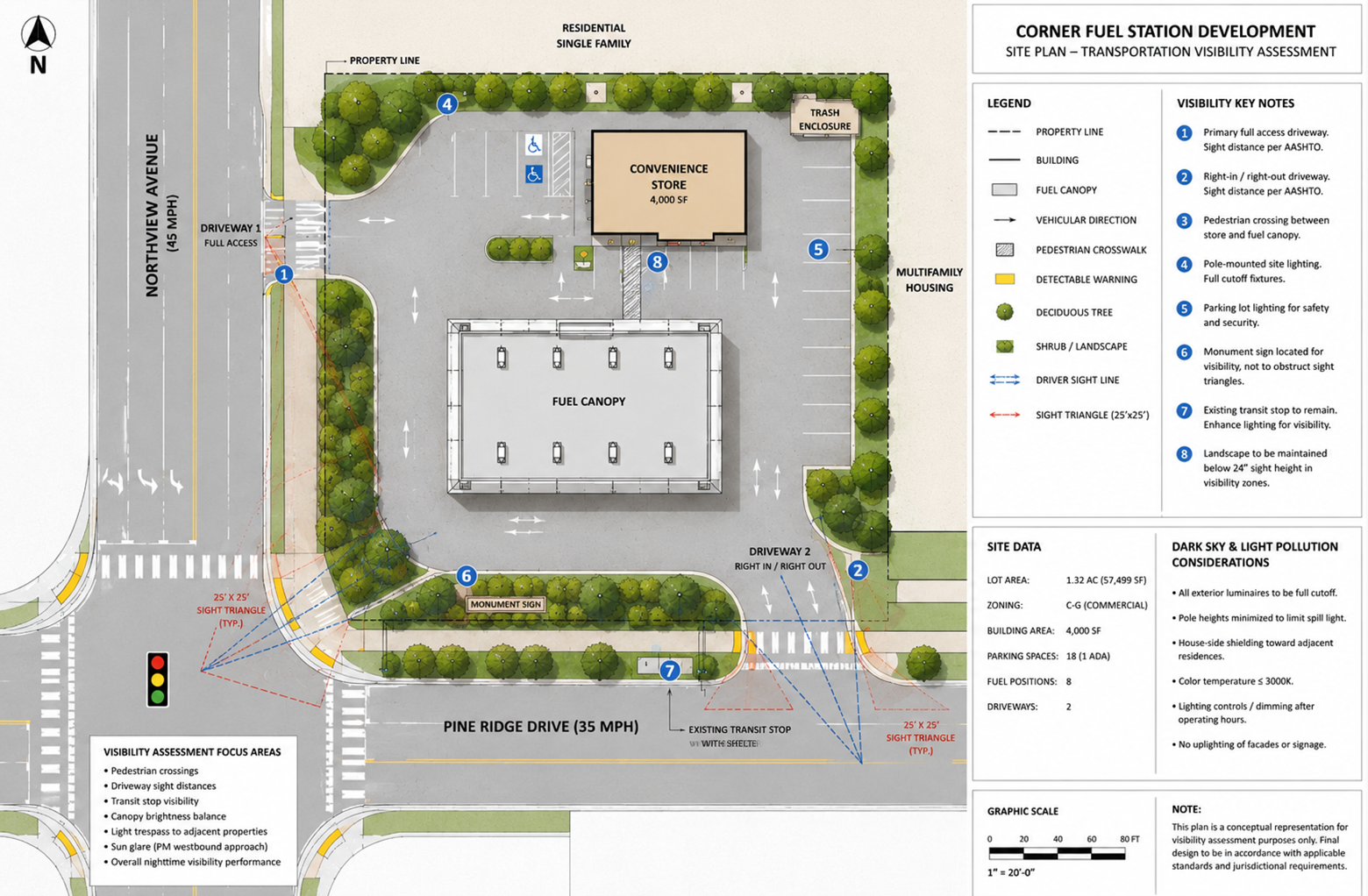
The graphic above illustrates what a transportation visibility strategy could look like during site planning. The intent is not to establish lighting levels or prepare construction documents, but rather to identify visibility-related considerations that will influence future design decisions during the day, but also at night.
By understanding how users are expected to move through an environment during both daytime and nighttime conditions, project teams can begin identifying where visibility may be most critical long before detailed design begins.
Human Factors Framework
Every transportation user moves through four basic stages before taking action:
Detection – Can the user see it?
Recognition – Can the user identify what it is?
Interpretation – Do they understand what it means?
Response – Do they have sufficient time to react?
Visibility strategies can influence each of these stages and provide a useful framework for evaluating future user experience.
Establishing Visibility Priorities During Planning
Throughout the planning process, transportation professionals routinely forecast how people will move through a community. They evaluate future traffic demand, pedestrian activity, transit usage, and multimodal connectivity long before construction documents are prepared.
Visibility may deserve consideration alongside those discussions. Not because lighting design should occur earlier, but because many of the decisions that ultimately influence visibility are established long before lighting design begins.
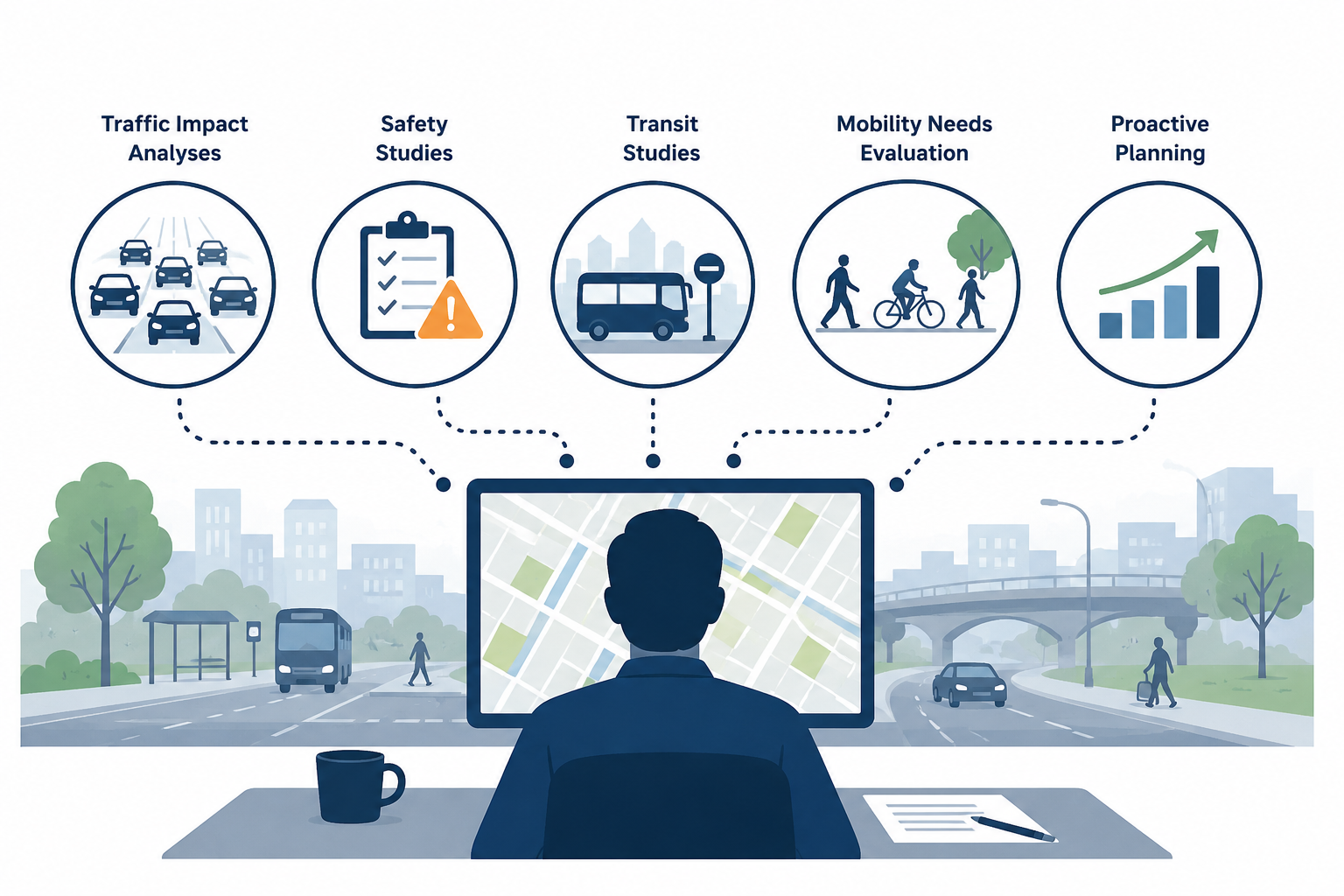
Building locations are established. Sidewalks are established. Crossings are established. Access points are established. The expected users of the space are often well understood.
By the time a lighting designer begins placing poles and running calculations, many of the visibility outcomes have already been influenced.
Perhaps the question is not whether visibility belongs in planning.
Perhaps the question is how intentionally it is considered before design decisions are established.
References / Citations
FHWA's Nighttime Visibility for Safety
Authors Note & Commentary
The perspectives presented in this article are based on the author's professional experience in transportation engineering, roadway lighting design, and field observations of transportation facilities. The article is intended to encourage discussion regarding the role of roadway lighting within transportation engineering practice.